
How to tell if your agency is the problem or your brief is.
Most agency failures look identical from the outside, but they require opposite responses. Before you fire your marketing agency, run the symmetric three-document audit to see if the problem is them or the brief you handed them.
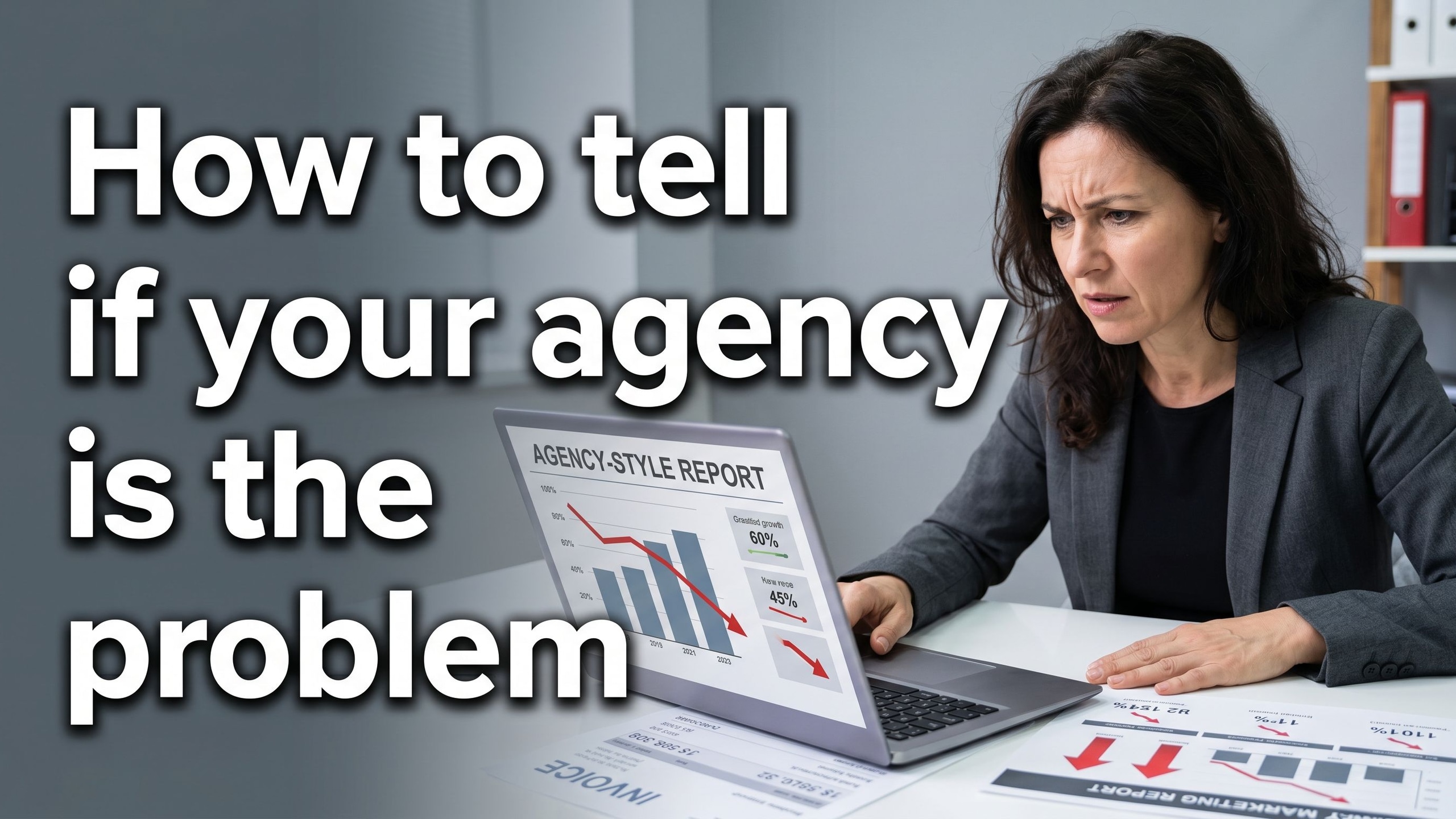
You just got the quarterly report. Pipeline is flat. The retainer hit your bank on the first. You are doing the math: nine months, six figures spent, no lift you can point to on the revenue line.
You're about to fire them. Or re-sign them. You don't know which, because you cannot tell whether the agency is underdelivering or whether the brief they were handed was impossible to execute against.
That's the actual problem. It isn't the agency. It's that you cannot diagnose.
The founder who can't diagnose the failure will either fire a competent agency and lose six months rebuilding, or re-sign an incompetent one and lose another year. Both outcomes cost roughly the same. A year of runway, and the strategic window that ran out during it. The second cost is the one most founders never price in. The market your marketing was supposed to move did not wait for you to figure out who to blame. Before you decide anything, run the symmetric audit.
The two failure modes are not the same failure
There are two ways an agency engagement fails, and they look almost identical from the outside.
Agency-side failure looks like reports full of impressions, reach, CTR, and sessions, with no line connecting any of it to pipeline or revenue. It looks like weekly calls where nobody challenges your assumptions. It looks like a media plan you could have bought off a shelf. Agency-side failure is an execution problem dressed up as a strategy problem. The tells are well-documented. Activity metrics untethered from outcomes. A rushed discovery phase. A template proposal dressed as a custom plan. A twelve-month lock-in with no performance clause. A team that never pushes back on your brief. If you're seeing three or more of these, you're almost certainly looking at an agency problem.
Brief-side failure looks like an agency executing flawlessly against a target that was never commercially coherent. Great creative. On-brand content. Campaign delivery on time and under budget. A pipeline that still does not move. The tells are different and quieter. The agency has no access to your CRM. They have never heard a sales call. Their monthly report grades them on traffic because that's the only metric in the SOW. You've changed your ICP twice this year and not told them. The sales team cannot name the campaigns the agency is running. The feedback loop runs one direction: you brief, they execute, you review creative, repeat. There is no closed loop between what marketing produced and what sales closed.
These two failures produce the same financial result. They require opposite responses. Fire the agency in case one and the next agency will hit the same wall six months from now. Fire the brief in case two and you'll just exhaust your second retainer the same way. The decision is not which agency. The decision is which failure mode.
Most advice treats only one side of this diagnostic
Search for how to tell if your marketing agency is working and every article you read is written from one assumption. The agency is on trial and the founder is the jury. Look at the reports. Look at the contract. Look at the communication cadence. Fire them if they fail.
That framing is incomplete. It treats the founder's inputs as correct by default. In practice, more than half of the agency failures I have diagnosed in operator businesses under ten million in revenue were brief-side. The agency was competent. The brief was a wish, not a specification. The founder was running a commercial system with a gaping hole at the top of it, and the agency was paid to fill a much smaller hole further down. When you hire on a wish, you get campaigns built to a wish. They will be beautifully produced. They will not move revenue.
This is not a comfortable read, because it implicates you. Good. If your only lever is hire a better agency, you are one bad quarter away from the same result.
The three-document audit
Before you decide whether to fire the agency, before you call a peer, before you open a new RFP, run this audit. It takes forty-five minutes and you can do it today.
Pull three documents. The last brief or SOW you signed with the agency. Their most recent monthly report. Your current pipeline report from the CRM.
Lay them side by side. You are looking for one specific thing. Do they share a vocabulary?
If the SOW says drive awareness and engagement, the report says reach up 38 percent and sessions up 22, and the pipeline report says qualified opportunities down 14, those three documents are not in the same language. The agency was briefed on awareness and reported on awareness. The pipeline does not move because nothing in the engagement was ever tied to pipeline. You did not buy marketing. You bought media. The failure is upstream of the agency.
If the SOW says generate forty MQLs per month at a CAC under nine hundred, the report shows pacing and cost against that number, and the pipeline report shows MQLs translating to opportunities and revenue, then the three documents are in the same language. Now you can evaluate the agency on the job they were actually hired to do. If the numbers are missing, you have a real case. If the numbers are there but the pipeline still isn't moving, you have a different conversation, which is whether MQLs are the right target at all. That's a strategy problem, not an execution problem, and it is still yours.
A second test. Does the agency have access to your CRM, and have they ever sat in on a sales call? If both answers are no, they are not running demand generation. They are running a media buy. You can fire them, but you cannot expect a replacement to do better until you fix the access problem. Agencies without CRM access are optimizing against proxies for the thing you want. Proxies drift. Proxies lie. The agency that is closer to your sales floor than your marketing floor will outperform the one with the prettier deck every time.
A third test. Is there a named commercial owner on your side for the marketing engagement? Not a project manager. Not a founder who checks in. Someone whose number is hit or missed based on what the agency delivers. If the answer is no, the agency has no counterparty. They are optimizing against the only feedback they get, which is your monthly creative review. That is why the work feels well-executed and irrelevant at the same time. Without a counterparty, an agency defaults to pleasing you rather than pressuring you, and a pleased founder is a leading indicator of a flat pipeline.
What this means before the end of today
Do the three-document test before you close this tab. If the documents do not share a vocabulary, the diagnosis is brief-side, and firing the agency is not the move. Rewriting the brief is. Change the SOW to list two or three commercial outcomes the agency's work is expected to influence, with numbers attached. Give the agency read access to your CRM and a standing seat on one sales call a week. Name the internal owner.
If the documents do share a vocabulary and the numbers are missing anyway, the diagnosis is agency-side. Write a thirty-day improvement plan, in writing, with specific pacing targets. If they cannot meet it, you have your answer and you have documentation. Start the next search with a better brief in hand, which you now have, because you just wrote one.
Do not make the decision before you run the audit. A fired agency you needed is more expensive than a retained agency you should have fired. The diagnostic is not optional.
— Stacey Tallitsch, Stronghold CMO