
Before you approve budget for an AI SDR, run these four checks
A consultant pitching an AI Sales Development Representative tool will show case studies and savings projections. Most founders cannot tell from those whether the tool will work for their business. Here is the diagnostic that runs before the deck.
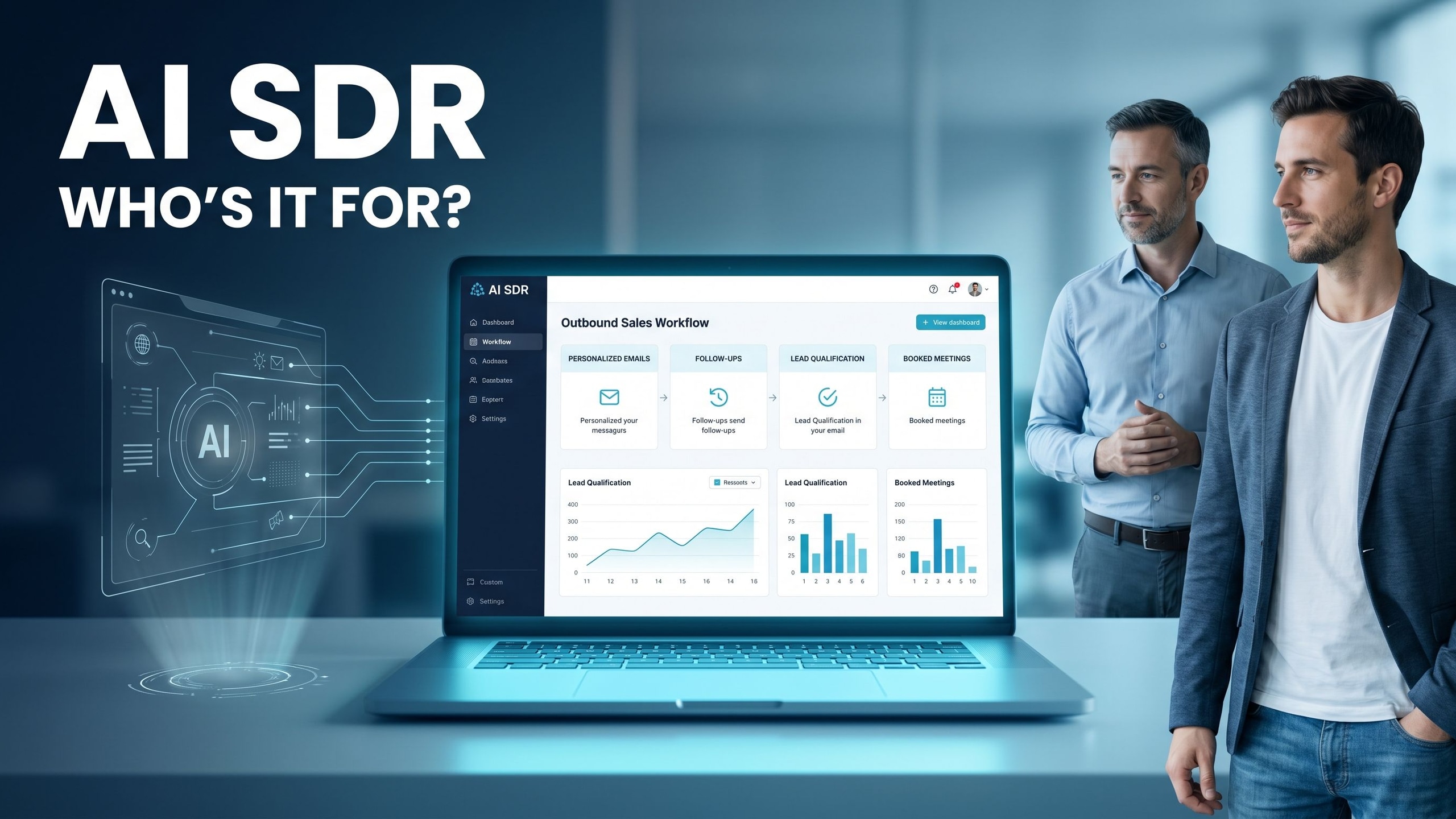
A consultant comes into your office with a deck. The deck shows an AI Sales Development Representative — an AI SDR — that will write personalized outbound email at scale, replace one or two human sales hires, and deliver pipeline for less than the cost of a single salaried rep. The case studies look real. The projected savings look conservative. The founder of the case-study company says it changed his business.
You sit there with the deck open and you cannot tell whether to approve the budget or pass.
This is the most common AI evaluation moment of 2026. Whatever your industry, someone has pitched you an AI SDR by now. You suspect the demo is hiding something but cannot name what. You suspect the case studies are cherry-picked but cannot prove it. You know that 90 days from now you will either be glad you bought it or quietly killing the contract, and the deck does not tell you which one.
This post is the diagnostic that runs before the deck.
What you are actually buying
Strip the marketing language and an AI SDR is a stack of three things bolted together. A list of contacts you bought or scraped. A templating engine that uses a language model to write a "personalized" email per contact. A sending infrastructure — domains, mailboxes, warmup tools, deliverability monitoring — that gets the email into the inbox without triggering spam filters.
That is it.
The marketing emphasizes the middle piece — the personalization layer — because it is the only part that is new. Sending infrastructure has existed for 20 years. Bought lists have existed for longer. The novelty is the model writing the body. Vendors charge $700 to $2,500 a month for that novelty, sometimes more.
The first thing this changes about how you evaluate the pitch: you are not buying an AI. You are buying a more efficient way to send templated email to a bought list. If templated email to bought lists has never worked for your business, an AI SDR will not change that. It will just do it faster.
The four checks
Before you sign anything, four things have to be true. If any one of them is not true, the tool will produce nothing or worse than nothing — and the case studies in the deck cannot tell you whether they are true for you.
The first check: you already have a working outbound motion you are trying to scale. Not a hypothesis about outbound. A motion. You or someone on your team has sent cold email to a defined audience, gotten replies at a rate you can name, booked meetings at a rate you can name, and closed deals from those meetings at a rate you can name. If you cannot produce those numbers from the last 90 days, you do not have an outbound motion. You have a wish. AI SDRs scale motions, not wishes.
The second check: you have a reliable source of contacts that match your ideal customer. The model cannot manufacture good leads from nothing. Whatever list it works from has to be accurate, current, and segmented. Most founders underestimate this — they assume the AI will figure out who to contact because the demo made it look that way. The demo used a small, hand-curated list. Production runs use whatever data source you give it. If your list is 20% wrong contact info and 40% wrong persona, you are sending 60% of your emails to wrong people, and your domain reputation pays the bill.
The third check: you have message-market fit on the offer. The cold email needs to reference a problem your prospect actually has, in the language they use, with a credible reason to respond now. This is the part of cold email that has always been hard. AI does not solve it. It generates language fluently, but it does not know whether the language matches the prospect's reality. If your offer sounds compelling to you and confusing to your prospect, the AI will scale that confusion across thousands of inboxes.
The fourth check: you have someone to handle replies who knows the offer cold. This is the check most founders miss. AI SDRs generate replies — sometimes a lot of them, often confused or off-topic — and someone has to read each one, decide whether it is a real opportunity, route it appropriately, and respond fast enough to keep the prospect warm. If you do not have that person, the leads die in the inbox. The AI did its job and you saw nothing for it.
Now the part the consultant's deck does not show.
An AI SDR is not a sales hire replacement. It is a sending volume multiplier. Those are different things, and confusing them is how early data suggests these tools are frequently canceled within the first quarter when the underlying outbound motion is weak. A good human Sales Development Representative diagnoses prospects, builds list quality, learns from replies, adapts language, and develops judgment about which conversations to push and which to drop. An AI SDR does none of that. It executes whatever input you give it at higher volume than a human can. That has real value when the inputs are strong. It is actively destructive when the inputs are weak — because the output is now thousands of emails to confused prospects on a domain you also need for human communication.
The better question to ask the consultant is not whether the AI SDR will work for your business. It is what you would have to already be doing for the AI SDR to multiply it. If you cannot point to a working motion, a working list, a working offer, and a working reply handler, you are not buying scale. You are buying the optics of scale.
The third party who actually benefits from your purchase, in many cases, is the consultant being paid a referral fee by the vendor. Worth asking.
The cost the deck does not show
The sticker price on an AI SDR is not the cost of running an AI SDR. Plan on 1.5 to 2 times the subscription price once you add the things the demo skipped.
Domain warmup and deliverability infrastructure runs $50 to $400 a month. Data enrichment, where the costs spiral hardest, often adds $250 to $1,000 a month. Ongoing human oversight — the 4 to 8 hours a week someone spends reviewing what the AI sent and what it generated as replies — is a real labor cost most teams underestimate at $15K to $30K a year in actual person-time.
And the largest cost is the one that never shows up on an invoice: the value of your company domain's reputation. Burn it with a poorly-configured AI campaign and your human-sent business emails — invoices, customer service responses, sales follow-ups, partnership conversations — start landing in spam. Recovery takes months. Some domains never fully recover. The HVAC owner who relies on email to confirm appointments and route service tickets cannot afford that outcome. Neither can a manufacturing firm whose customer service runs out of a shared inbox.
If a consultant pitched you an AI SDR this quarter, do not approve or reject the budget today. Take 45 minutes and run the four checks against your actual business.
Pull last quarter's outbound numbers, if you have them. List your top three customer profiles with the data sources where you would find more like them. Read the most recent cold email your team sent and ask whether a real prospect would respond to it. Name the person who would handle the replies if the volume tripled overnight.
If three or four checks come back clean, the tool can multiply what you already have, and the deck's projections may be roughly accurate. If two or fewer come back clean, you do not have an AI SDR problem. You have an outbound motion problem, and no tool will fix that for you. Tell the consultant you will revisit in two quarters.
— Stacey Tallitsch, Stronghold CMO
Quick reference
Should I hire an AI SDR for my business?
Only if you already have a working outbound motion you are trying to scale. AI SDRs multiply existing performance — if your outbound is weak, the tool scales the weakness across thousands of inboxes and damages your domain reputation in the process.
What does an AI SDR actually do?
It sends templated cold email at higher volume than a human can, with a language model writing per-contact "personalization." It does not diagnose prospects, build list quality, learn from replies, or develop judgment. Those are human Sales Development Representative functions.
What does an AI SDR really cost?
Plan on 1.5 to 2 times the subscription price all-in. The sticker is the smallest line item. Domain warmup, data enrichment, deliverability monitoring, and ongoing human oversight add $20K to $50K a year on top, and a damaged domain reputation is a cost most founders never see coming.